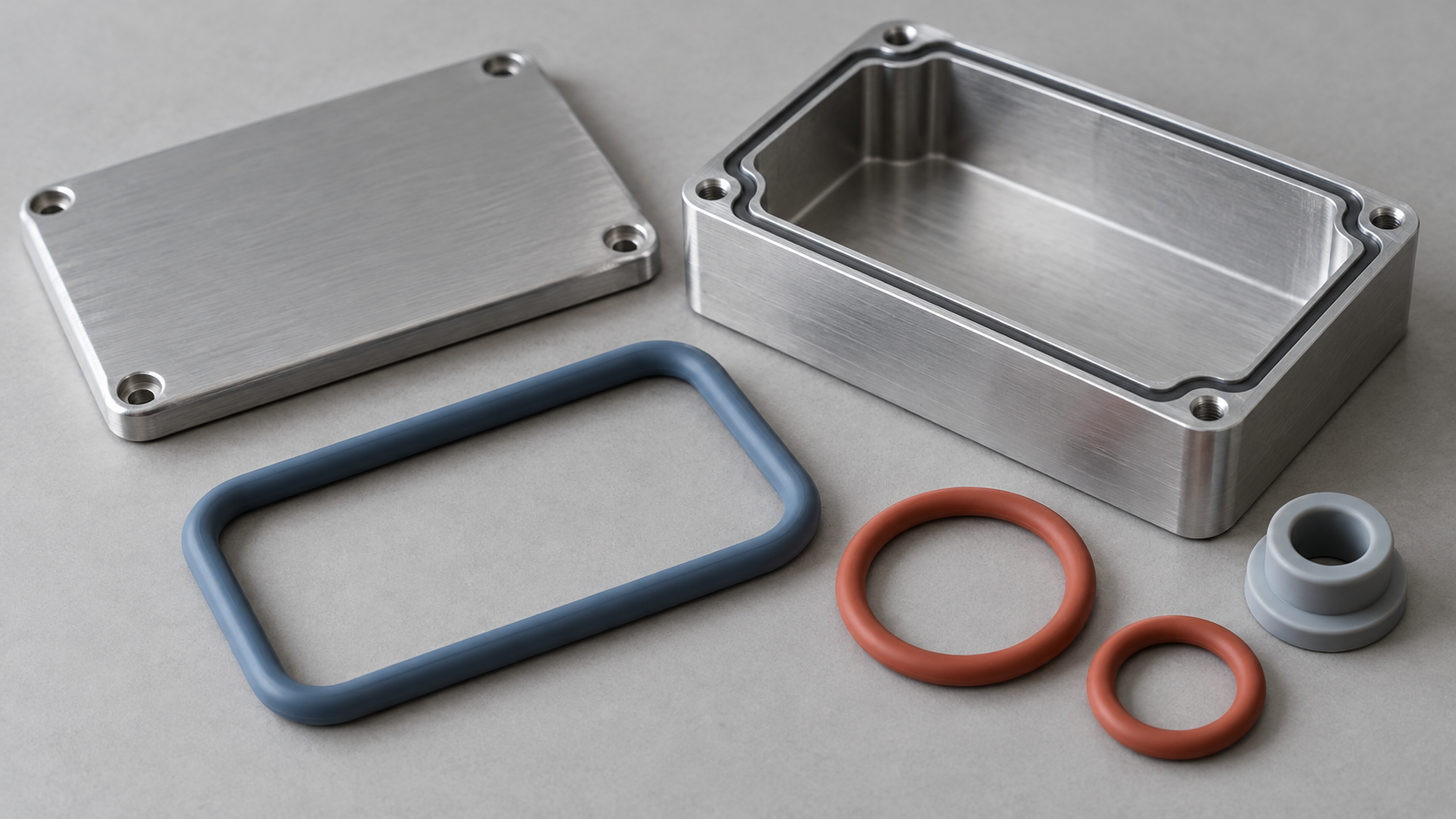
A silicone gasket can look right, fit the groove and pass an initial leak check. The harder question is what happens after it has spent months squeezed inside the product.
At DX, we recommend answering that question before approving a custom silicone seal. A low compression set value is useful evidence, but it does not describe every part of long-term sealing performance. Buyers also need to understand the test conditions, the assembled design and the force the seal retains during use.
Here is how we would turn those questions into a more useful specification for a new silicone gasket or molded sealing component.
What compression set actually measures
Compression set describes the deformation left after a compressed rubber specimen is released and allowed to recover under defined conditions. Lower values generally indicate better recovery when the same method and conditions are used. ASTM D395 covers several compression set methods and is mainly relevant to static compressive service. Its current listing is D395-18(2025), updated on February 21, 2025. [1, 2]
Consider a simplified constant-deflection example. A specimen starts at 2.00 mm thick, is held at 1.50 mm and recovers to 1.90 mm after release. The unrecovered thickness is 0.10 mm out of the original 0.50 mm deflection, giving 20% compression set. These are illustrative numbers, not DX test data or a recommended seal design.
That 20% figure does not mean the seal has lost exactly 20% of its sealing force, nor does it predict a particular service life.
Recovery and retained sealing force answer different questions
Compression stress relaxation measures how the force changes while an elastomer remains deformed. Parker explains that this is more directly informative about retained sealing force than measuring the deformation remaining after release. Both still depend on test and application conditions. [3]
For a cover that is opened during maintenance, recovery after release may be especially relevant. For a housing that stays closed, the retained contact force may deserve closer attention. We would decide which evidence matters from the product use case, rather than request a test simply because it appears on a supplier checklist.
This distinction also helps prevent an expensive misunderstanding: selecting the material with the lowest published compression set number does not, by itself, establish the best finished seal.
Compare the test conditions before comparing the percentages
Parker’s guidance on reading rubber test reports emphasizes the method and specimen behind the result. Specimen geometry can influence compression set results, so a molded test button and a small O-ring should not be treated as interchangeable evidence. [2]
For a purchasing review, we suggest putting each proposed material into the same comparison sheet:
| Information to request | Question it should answer |
| Method and specimen | Which standard, method, specimen geometry and specimen dimensions were used? |
| Exposure and recovery | What temperature, duration, medium, compression and recovery procedure were specified? |
| Material and preparation | Which compound, color formulation, cure and post-cure condition produced the result? |
| Meaning of the value | Is it typical supplier data, a guaranteed limit or a result measured on the supplied batch? |
If one result comes from a short exposure at a lower temperature and another from a longer, hotter exposure, we would ask for comparable testing before ranking them. A missing footnote can matter more than a small difference in the headline percentage.
A real supplier example shows why processing belongs in the discussion
WACKER’s July 2025 information sheet for ELASTOSIL LR 3078 describes self-adhesive LSR grades for selected rigid plastics. It reports low compression set without high-temperature post-curing, an important consideration when the plastic substrate limits the thermal treatment. Its property table specifies a press cure of 5 minutes at 165°C and compression set exposure of 22 hours at 125°C. The sheet also says its listed values are guidance rather than specification limits. [4]
Our takeaway for a custom project is practical: ask whether the proposed production route can reproduce the preparation behind the material data. For an overmolded seal, review the substrate and silicone together. For a separate molded gasket, agree the relevant cure and post-cure state before comparing samples.
This supplier example is not a statement that DX has qualified or currently uses LR 3078. Grade selection and processing suitability must be confirmed for the actual project.
Validate the assembled seal as well as the material
Parker notes that stress relaxation depends on the compound, processing, deformation, time, temperature and exposure medium. Its handbook also calls for compatibility checks under the relevant operating and cleaning conditions. [3]
We suggest agreeing a validation plan with three stages:
Start with a defined service profile
Write down normal and peak temperatures, exposure duration, pressure or vacuum, contact fluids, cleaning conditions and how often the product is opened. Include what counts as a failure: a measurable leak, moisture ingress, loss of closure function or another application-specific limit. Avoid approving a seal against a vague requirement such as “good heat resistance.”
Test representative assemblies
Use the intended housing, fasteners and production-representative silicone parts. Include the dimensional combinations that give the least and greatest compression, as agreed during the design review. Check the assembly before and after the relevant aging or cycling sequence. If opening and resealing is part of normal use, include that step too.
Connect approval to production
Record the approved compound, drawing revision, critical dimensions, processing state and test procedure. Agree who performs each test, how samples are selected and what changes require another review. A change of material or post-cure procedure should trigger a documented assessment of whether the original approval still applies.
These are our proposed project-planning steps. The exposure levels, acceptance limits and sample quantities need to be set for the application; this checklist does not establish a universal qualification protocol.
Write a quotation brief that leads to useful answers
Instead of sending only a hardness and a drawing, give your silicone seals manufacturer enough information to discuss performance and cost together. We would start with:
The seal drawing or 3D model, mating-part geometry and critical tolerances.
The operating and cleaning conditions, plus expected service or replacement interval.
The failure criteria and any required compression set, force-retention or assembly tests.
The target market, required documentation, order quantity and expected annual volume.
Any restrictions on material, color, surface treatment, post-curing or packaging.
If a requirement is still undecided, mark it as open. That gives both teams a clear question to resolve during sampling, instead of allowing an assumption to become a production commitment.
Develop your custom silicone seals with DX
DX offers mold development, compression molding, liquid silicone injection molding and silicone overmolding. Our published quality-control capabilities include dimensional checks and mechanical-property testing, including compression set. The test scope for a particular project should be agreed separately. [5, 6]
Planning a custom silicone gasket, O-ring or molded sealing component? Send us your drawing or sample, mating-part details, working conditions and expected quantity. We can review the material and manufacturing options with you and identify the requirements that need to be confirmed before production.
Contact DX to discuss your custom silicone seal project.
References
Sources checked October 15, 2026. Supplier examples describe supplier information, not DX qualification results. The planning checklist is DX editorial guidance.
1 ASTM D395-18(2025) public scope and significance
2 Parker How to Read a Rubber Seal Test Report
3 Parker O-Ring Handbook especially section 8 20 and compatibility guidance
4 WACKER ELASTOSIL LR 3078 information sheet July 2025
DX provides you with all-around silicone product customization services for valued customers like you.